How to Grow Rice: The Complete 2026 Farming Guide
Half the world wakes up and eats rice. Yet the gap between a field that yields one tons per hectare and one that yields six often comes down to a handful of decisions any farmer can learn. Learning how to grow rice well is less about secret tricks and more about understanding the plant, then building your season around what it needs at each stage.
I have grown rice on flooded clay, on dry upland sand, and on valley bottoms that flood one year and crack open the next. This guide brings that field experience together with current 2026 data from sources such as the Food and Agriculture Organization (FAO), the United States Department of Agriculture (USDA), the International Rice Research Institute (IRRI), and AfricaRice. You will get the full picture, from choosing a variety to drying the grain, written plainly so you can act on it.
Here is the honest truth up front. In 2026 you are planting into a soft price market with high input costs, so the farmer who wins is the one with the lowest cost per kilogram and the cleanest, best dried grain. Efficiency and quality beat raw volume this year. Let us get into exactly how to achieve both.
Key takeaways
- Rice grows in five systems: irrigated lowland, rainfed lowland, upland, deepwater, and tidal. Match your variety and method to your water first.
- Sow seed 3 to 4 cm deep. Emergence falls from about 71 percent at 1 cm to about 2 percent at 6 cm.
- Never stress the crop for water from panicle initiation through flowering. This window sets and fills your grain.
- Time the main nitrogen dose to panicle initiation, applied into 2 to 3 cm of standing water.
- Weed early. In trials, weeding lifted yield roughly five fold, from under 1 t/ha unweeded to over 5 t/ha kept weed free.
- Dry grain slowly, losing less than 3 percent moisture per day, down to 14 percent or below. Fast drying cracks grain into low value brokens.
- Alternate Wetting and Drying (AWD) can cut water use by up to 30 percent and methane by 30 to 60 percent while holding yield steady.
What is rice and why does it matter in 2026?
Quick answer: Rice is a cereal grass grown for its edible grain, and it feeds about half the world while supplying more than a fifth of all calories humans eat. In 2026 the market is well supplied and prices are soft, so growing rice profitably depends on low costs and clean, high quality grain.
Rice is the staple food for roughly half of humanity, and no other major cereal grows across such a wide range of water conditions, from dry upland slopes to fields standing under several metres of flood. That flexibility is biological. Rice builds internal air channels that carry oxygen from its leaves down to its roots, which is why it can thrive with its feet underwater where maize or wheat would drown.
The 2026 rice market in plain terms
World rice production sits near a record, at roughly 541 million tonnes of milled rice for the 2025 and 2026 season, with consumption a touch lower and total supplies at record highs (FAO and USDA reporting, early 2026). India now leads the world on both counts. It produces more than 150 million tonnes and supplies close to 40 percent of all rice traded across borders, so what India does with its surplus moves world prices more than any other single factor.
Three forces define the year for growers. Prices are soft because supplies are large and the big exporters are competing hard. Costs are high, with fertilizer and diesel squeezing margins from the other side. And the weather is a wildcard, with a strong El Nino expected through the 2026 and 2027 northern winter that could cut Asian output and firm prices. Plan for thin margins, and treat any price rally as a bonus, not a baseline.
What this means for you. Compete on cost per kilogram and on grain quality, not on raw tonnage. A clean, well dried crop that earns a quality premium will beat a bigger, poorly handled one in a soft market.
What are the main types of rice?
Quick answer: There are two cultivated species, Asian rice (Oryza sativa) and African rice (Oryza glaberrima). Asian rice splits into indica (long grain, loves heat), japonica (short, sticky, cold tolerant), and aromatic types such as basmati and jasmine. Grain type decides who buys your rice and at what price.
Almost every rice plant on earth is one of two domesticated species. Oryza sativa, Asian rice, carries nearly all of the high yielding modern varieties grown worldwide. Oryza glaberrima, African rice, is hardy and weed competitive but lower yielding, and its great modern role is as a parent of the NERICA varieties bred for Africa.
The subspecies that change how rice behaves
Asian rice is not uniform. Knowing your group tells you a lot before you even plant.
| Group | Grain and character | Climate niche | Examples |
| Indica | Long, slender grain; tillers heavily; loves heat and water | Tropical and subtropical lowlands | IR64, Supa |
| Temperate japonica | Short, round, sticky grain; cold tolerant; stiff straw | Cooler, higher latitude climates | Koshihikari |
| Tropical japonica | Bold, large grain; vigorous; drought tolerant | Uplands and tropical highlands | Moroberekan |
| Aus | Early, fast growing, stress tolerant | Eastern India and Bangladesh | Source of stress genes |
| Aromatic | Fragrant, premium long grain | Premium niche markets | Basmati, Jasmine |
The practical lesson is simple. An indica variety planted in a cold highland will struggle, a temperate japonica in the hot tropics will not tiller well, and a tropical japonica is your friend on a dry slope. Match the group to your climate first, then refine.
Grain types and the market
The market does not buy rice, it buys grain types and pays different prices for each. Long grain cooks dry and separate and dominates world trade. Medium and short grain is plumper and stickier, prized in East Asia. Aromatic types such as basmati and jasmine sell at a premium. Glutinous sticky rice is a distinct market, and parboiled rice is a processing route that raises nutrition and milling yield. Know what your variety produces before you plant, because it sets your buyer and your price.
What do rice plants need to grow?
Quick answer: Rice needs warmth (about 25 to 30 degrees Celsius), plenty of water, strong sunlight, and a mildly acidic to neutral soil (pH about 5.5 to 7.0). The most sensitive moment is flowering, when heat above about 35 degrees or cold below about 18 to 20 degrees can leave grains empty.
Every rice crop is governed by a few measurable conditions. Get these right and the rest of farming becomes easier. Get them wrong and no amount of fertiliser will rescue the yield.
Temperature: the master control
Rice is a warm season crop that does best with mean temperatures in the mid 20s to low 30s Celsius. Two windows matter most. Flowering is the single most heat and cold sensitive moment, when a brief spell of extreme temperature can sterilise the flowers and leave empty grain. Grain filling prefers cooler nights, which give plumper, higher quality grain. In a warming climate, timing flowering away from the hottest part of the season is an increasingly valuable skill.
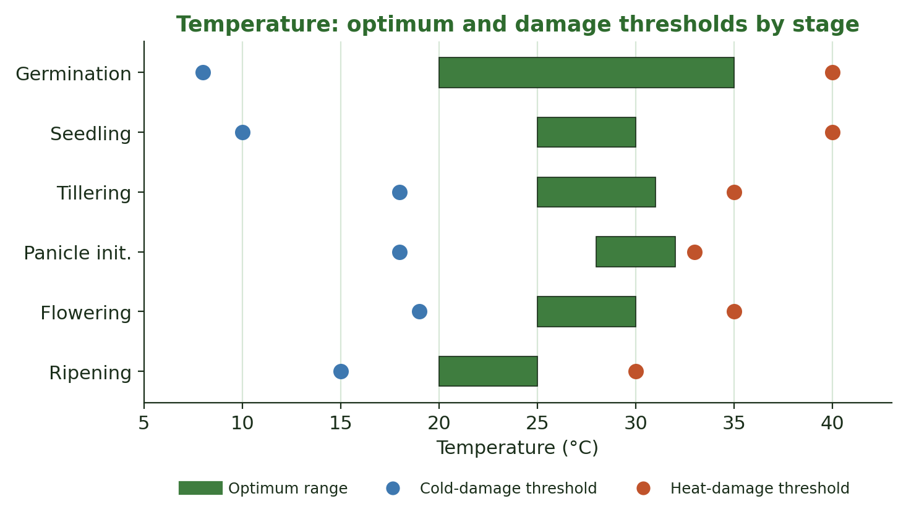
Figure. Rice temperature requirements by stage. Optimum bands are shown with the cold and heat thresholds that damage the crop. Flowering is the most sensitive stage for grain set.
Water, sunlight, and altitude
A flooded lowland crop transpires and evaporates on the order of 1,000 to 2,000 mm of water over a season, which is why rice uses close to 40 percent of the world’s irrigation water. For rainfed and upland rice, a useful rule is that the crop does well where each five day period brings more than about 20 mm of rain, from sowing until roughly 15 days before harvest. Bright sunshine during reproductive growth and ripening strongly lifts yield, so dry season irrigated crops often beat wet season ones. Altitude works mainly through temperature, and rice is most reliable below about 1,000 m in the tropics, becoming marginal above roughly 1,700 m without cold tolerant varieties.
Soil and pH
Rice grows on a huge range of soils but does best on heavy clays and clay loams that hold water and nutrients. The sweet spot for pH is mildly acidic to neutral, about 5.5 to 7.0. A handy quirk of flooding is that submerged soil drifts toward neutral over a few weeks, so flooded rice tolerates a wider starting pH than upland rice. Where rainfall, elevation, and pH are all favourable, you have prime rice ground.
| Factor | Not suitable | Suitable | Very suitable |
| Annual rainfall | Below 800 mm | 800 to 1,200 mm | Above 1,200 mm |
| Elevation | Above 1,700 m | 1,000 to 1,700 m | Below 1,000 m |
| Soil pH | Below 4.5 or above 7.0 | 4.5 to 5.5 | 5.5 to 7.0 |
A field with two of these three factors favourable is usually worth planting. All three favourable means prime rice ground.
Useful tools: Check your ground with the soil pH adjuster and lime calculator and the soil texture classifier, or browse the full set of soil and land calculators for more soil prep planning.
What are the five rice growing systems?
Quick answer: Rice grows in five systems defined by water: irrigated lowland (controlled flood, highest yield), rainfed lowland (rain fed flood), upland (rain only, no standing water), deepwater (seasonal deep flood), and tidal or coastal (salinity risk). Your system decides your variety, planting method, and water plan.
Rice is really several crops in one, separated by how water reaches the field. Everything downstream, from variety to weeding strategy, flows from which system you farm. Be honest about which one you have before you spend a shilling.
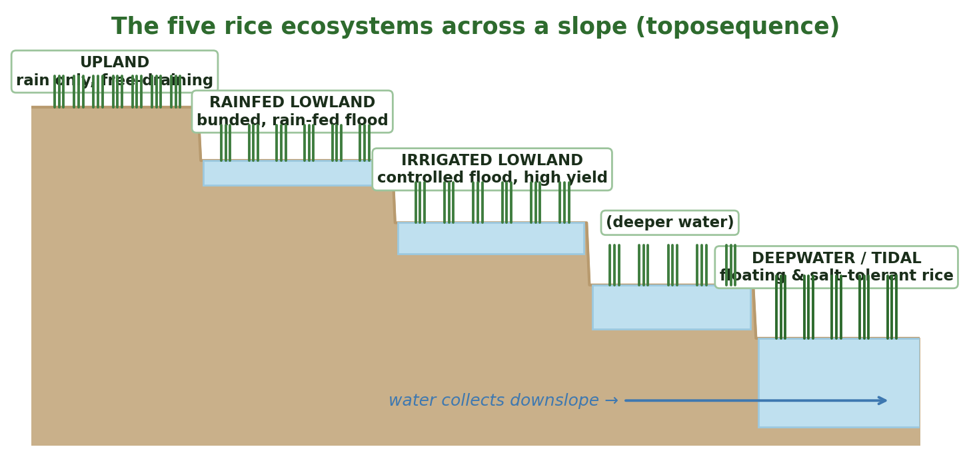
Figure. The five rice growing systems are arranged across a slope. Water collects downhill, so the system and the right variety change with position in the landscape.
| System | Water source | Typical yield | Share of world rice |
| Irrigated lowland | Controlled irrigation, flooded | 5 to 10 t/ha | About 75 percent of output |
| Rainfed lowland | Rain, bunded, variable flood | 2 to 4 t/ha | About 19 percent of area |
| Upland | Rain only, free draining | 1 to 4 t/ha | About 9 percent of area |
| Deepwater and floating | Seasonal deep flood (0.5 to 4 m or more) | 1 to 2 t/ha | Small, local |
| Tidal and coastal | Tidal wetlands, salinity risk | 2 to 4 t/ha | Small, local |
Irrigated lowland produces most of the world’s rice on a minority of its land, because controlled water unlocks high, stable yields. If you farm rainfed or upland ground, your main insurance policy is variety choice, because you cannot control the water. Build strong bunds to capture every rain, level the field well, and on upland slopes terrace and harvest water so heavy storms do not wash seed downhill.
Plan ahead: Size your plot with the land area converter and map out your season with the crop calendar generator. See more in the crop management calculators.
How do you choose the best rice variety?
Quick answer: Match the variety to your water first, then demand the traits that survive your worst likely season. Use submergence tolerant SUB1 varieties on flood prone land, drought tolerant varieties on dry rainfed ground, salt tolerant varieties on coastal soils, and NERICA or tropical japonica types on uplands.
Seed is the cheapest decision that shapes everything else, so choose well. Start with the single most important question: does this variety fit my water?
| Your land | Variety family | Traits to demand |
| Upland or dry slope | NERICA and tropical japonica | Drought tolerance, blast resistance, early maturity |
| Rainfed lowland | Improved indica, stress tolerant lines | Submergence and drought tolerance, local disease resistance |
| Flood prone valley | SUB1 submergence tolerant | Survive 1 to 2 weeks full submergence and recover |
| Drought prone rainfed | Drought tolerant varieties | Reproductive stage drought tolerance, early vigour |
| Saline or coastal | Salt tolerant varieties | Salinity tolerance, good seedling vigour |
| Irrigated lowland | High yielding inbreds or hybrids | Yield, lodging resistance, grain quality, disease package |
Inbred or hybrid rice?
Inbred varieties breed true, so you can save and replant seed for several seasons if you rogue out off types. Hybrids cost more and need fresh seed every season, but they can yield 10 to 20 percent more. In a low price year, weigh the hybrid yield gain against its higher recurring seed cost. For many rainfed and upland farmers, a strong inbred is the sound choice.
The climate smart traits of 2026
The biggest change since the old manuals is the arrival of varieties carrying specific stress tolerance genes. SUB1 varieties survive complete flooding for one to two weeks and then recover, which saves crops on flash flood land. Drought tolerant lines such as the Sahbhagi Dhan family hold yield through dry spells, and researchers in 2025 and 2026 identified new gene variants that protect yield under water stress at flowering. Salt, heat, and cold tolerant lines are spreading, and the frontier now is stacking several of these traits into one short duration, disease resistant variety. Biofortified rice bred for extra zinc or vitamin A adds nutrition at no extra growing cost.
The discipline of variety choice. A variety that yields 6 t/ha in a perfect year but dies in a flood is worth less than one that yields 4 t/ha and survives. In a volatile climate, resilience is itself a yield strategy. Always check what pest and disease resistance a variety carries against the threats in your own district.
Plan your rotation: Pair your chosen variety with a sound rotation using the crop rotation planner, and work out how much seed you need with the seed rate calculator.
How do you prepare the soil for rice?
Quick answer: Level the field well, build sound bunds, and work the soil to a fine tilth. For lowland rice, puddle the wet soil to control weeds and reduce water loss. Correct any problem soils, such as saline, acid, or zinc deficient ground, before planting, and build organic matter with manure, compost, and returned straw.
Good land preparation pays back all season. A well levelled field uses water and fertiliser evenly and gives clean weed control, while an uneven one wastes both and grows patchy. For lowland systems, puddling (working wet soil into soft mud) controls weeds, eases transplanting, and forms a hardpan below that slows water loss. Where water is scarce or methane matters, farmers are moving toward less puddling, using dry direct seeding and aerobic methods that trade some weed control for big savings in water and labour.
Fixing problem soils
| Problem soil | Sign on the crop | What to do |
| Saline or sodic | Stunting, poor tillering, white leaf tips | Salt tolerant variety; flush with good water; gypsum on sodic soils |
| Acid sulfate | Severe stunting, orange coated roots, very low pH | Lime; careful water management; tolerant varieties |
| Iron toxicity | Bronzed, purple brown leaves, scorched tips | Drainage, lime, balanced potassium and phosphorus |
| Zinc deficiency | Bronzing and stunting weeks after transplanting | Zinc sulphate to soil, or dip seedling roots in zinc |
| Sandy and leaky | Rapid water and nutrient loss | Split fertiliser into more doses; add organic matter; level well |
Three habits build long terlong-termm fertility and cut your fertilizer bill: rotate rice with legumes and other crops to rest the soil and break pest cycles, return straw and stubble to recycle potassium and silicon, and add manure or compost to feed the soil slowly. In flooded fields, azolla and blue-green algae fix nitrogen for free.
Diagnose and correct: Identify shortfalls with the soil nutrient deficiency checker, work out lime or gypsum needs with the gypsum application calculator, and track fertility gains with the soil organic matter calculator.
How do you plant rice, step by step?
Quick answer: You can plant rice two ways: transplant nursery raised seedlings into a puddled field, or direct seed straight into the field. Whichever you choose, sow or plant 3 to 4 cm deep, use clean tested seed, and keep rows straight so you can weed between them. Transplant seedlings young, before 25 days old.
Nothing you buy returns as much as good seed, and nothing you do shapes the crop as much as how you put it in the ground. Before sowing, run two quick tests. Test germination by sprouting 100 seeds and aiming for at least 80 percent. Then float the seed in lightly salted water and sow only the sinkers, because plump filled grains sink and empty ones float.
Why sowing depth matters so much
Sow at 3 to 4 cm. Emergence falls off a cliff as you go deeper, from over 70 percent at 1 cm to barely 2 percent at 6 cm, with maturity delayed at greater depths. Deep sown seed burns energy fighting to the surface and grows oxygen starved roots on the way. This is the rule farmers break most often.
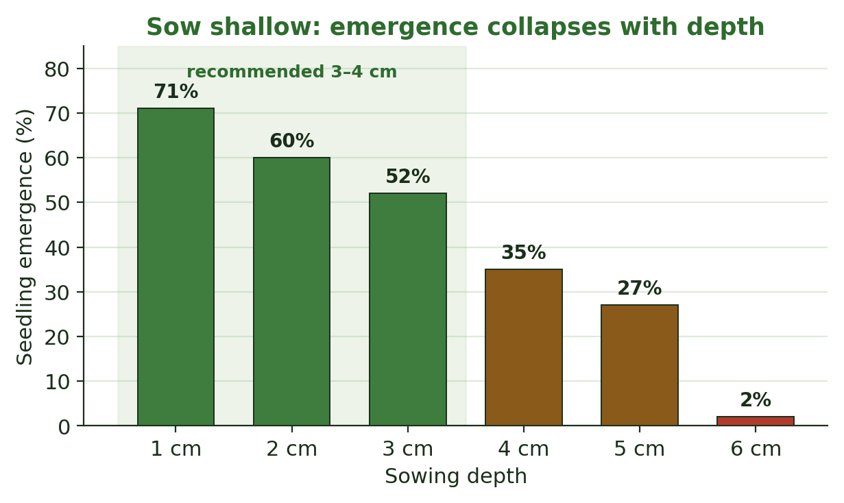
Figure. How sowing depth affects rice seedling emergence. Emergence is highest at 1 to 2 cm and collapses by 6 cm, which is why the recommended depth is 3 to 4 cm.
Transplanting: a simple step by step
- Raise a wet nursery bed 1 m wide, sow pre soaked seed at about 100 g per square metre, and do not cover the seed with soil. About 100 to 150 square metres of nursery raises enough seedlings for one acre.
- Keep the seedbed shallow and wet, and never let the surface dry out.
- Lift seedlings at about 16 to 21 days old, before 25 days. Old seedlings tiller poorly and never catch up.
- Plant shallow, 3 to 4 cm deep, with 3 to 4 seedlings per hill.
- Use a spacing of about 20 by 20 cm or 25 by 25 cm, closer on less fertile soil, and keep the rows straight so you can run a rotary weeder.
- Walk the field about 10 days later and refill any missing hills. Gaps are pure lost yield.
Get the stand right: Check your spacing with the row and seed spacing calculator, confirm your target density with the plant population density calculator, and track establishment with the transplanting success rate calculator.
Direct seeding: faster and water saving
Direct seeding sows seed straight into the field rather than transplanting, which cuts labour and water and lowers methane. Drilling or dibbling in rows beats broadcasting because straight rows let you weed between plants and apply inputs evenly. Dry direct seeded rice (DSR) shortens the flooded period by about a month, but weeds get a head start, so it needs a sharper weed plan. Mechanical transplanters and seeders speed the whole job and, in 2026, locally made machines have cut planting and harvest time sharply.
Time it right: Line up your sowing window with the planting date and maturity calculator and check local cold risk with the frost date calculator.
How much water does rice need, and how do you save it?
Quick answer: Rice needs steady water all season, but the make or break window is panicle initiation through flowering, when you must never let the field dry out. To save water, use Alternate Wetting and Drying (AWD): let the field dry until water sits about 15 cm below the surface in a tube, then re flood. AWD can cut water use by up to 30 percent.
Rice uses more water than most crops, partly through the plant and partly through evaporation and seepage. But it does not need water equally at every stage. Knowing the critical periods lets you save water when the crop can spare it and guarantee it when the crop cannot.
| Stage | Water sensitivity | Guidance |
| Establishment | Moderate | Keep moist; shallow water for transplants |
| Tillering | Lower | Tolerates mild drying; good window for AWD |
| Panicle initiation | High | Keep water on; do not let the field dry |
| Flowering | Highest | Never stress; keep standing water |
| Grain filling | Moderate | Maintain, then begin drainage late |
| Maturity | Low | Drain to firm the field for harvest |
How to run Alternate Wetting and Drying (AWD)
AWD is the flagship water saving method, and it is simple to run with a perforated tube sunk into the soil.
- Keep the field flooded normally for the first 1 to 2 weeks after planting so the crop establishes and early weeds stay down.
- Install a perforated field water tube where you can read the water level inside it.
- Let the field dry until the water in the tube falls to about 15 cm below the soil surface, then re flood to about 5 cm. The roots still reach water, so yield is not stressed.
- Stop AWD and keep continuous shallow water from panicle initiation through flowering, the sensitive window.
- Resume AWD during grain filling, then drain for harvest.
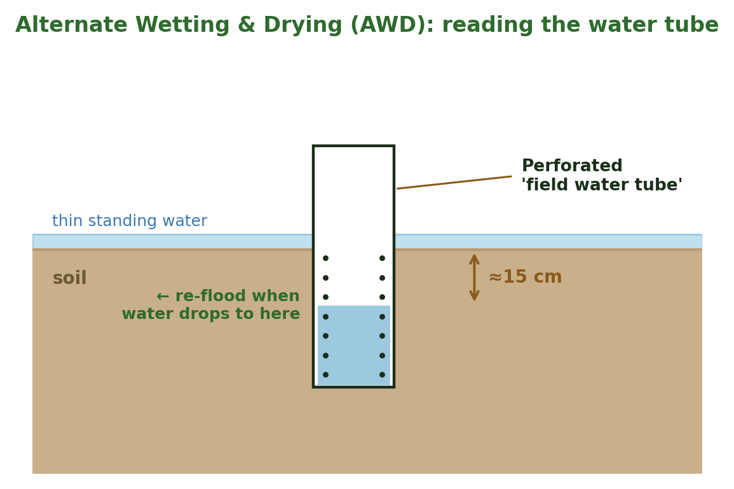
Figure. How to read the field water tube for Alternate Wetting and Drying in rice. Re flood when the water inside the tube drops to about 15 cm below the soil surface.
The payoff is real. AWD cuts methane emissions by roughly 30 to 60 percent and water use by up to about 30 percent, while holding yield steady or even lifting it slightly. The one caution is that over drying, especially a hard dry down at heading, can cost yield, so AWD is a discipline, not a set and forget. In 2026, verified AWD and dry seeding projects also pay farmers through carbon credits, so the same practice that saves water can earn a second income. Ask your extension service whether a climate smart rice programme operates in your area.
Run the numbers on water: Estimate field demand with the crop water requirement (ETc) calculator or the evapotranspiration calculator, size your flood with the flood irrigation water calculator, track dry down with the soil moisture deficit calculator, and benchmark savings with the water use efficiency calculator or the farm carbon footprint calculator for any carbon credit programme. See the full irrigation and water calculators.
How do you fertilize rice?
Quick answer: Feed rice mainly with nitrogen, phosphorus, and potassium. Split the nitrogen and place the biggest dose at panicle initiation, applied into 2 to 3 cm of standing water so it is not lost. Read the plant for deficiency signs, and correct zinc, sulphur, and other shortages on soils that need them.
Every harvest removes nutrients the soil cannot replace forever. Nitrogen drives tillering and grain number, but it is also the easiest nutrient to waste, because flooded soil lets it escape to the air or leach away. Two rules turn nitrogen from a cost into a return.
- Time it to demand. Split nitrogen and place the major dose at panicle initiation, when the plant is fixing grain number. Nitrogen dumped too early grows soft leaf and lodging risk instead of grain.
- Manage the water around it. When you topdress, hold 2 to 3 cm of standing water for about a week so the nitrogen moves into the soil rather than off in runoff. Where you can, place urea into the soil rather than broadcasting onto open water, which sharply cuts losses.
Two cheap tools help you get nitrogen right. A leaf colour chart lets you decide when the crop actually needs nitrogen instead of guessing by the calendar. Site specific nutrient management matches nitrogen, phosphorus, and potassium to your field and your target yield. With fertiliser prices high in 2026, this efficiency is the line between profit and loss.
Reading the plant for what it lacks
| Sign on the crop | Likely cause | What to do |
| Lower leaves yellow first, few tillers, stunted | Nitrogen deficiency | Topdress nitrogen into shallow water |
| Dark green, reddish or purple tinge, poor tillering | Phosphorus deficiency | Band phosphorus near the roots, early |
| Yellowing between veins, brown spots, weak straw | Potassium deficiency | Apply potassium; return straw |
| Bronzing and stunting weeks after transplanting | Zinc deficiency | Zinc sulphate to soil, or dip seedling roots |
| Younger leaves yellow (newer than nitrogen signs) | Sulphur deficiency | Use a sulphur containing fertiliser |
Inorganic fertilizer works fastest, but organic sources build the soil and cut your bill over time. Compost, manure, and incorporated straw release nutrients slowly and improve water holding. Green manures such as Sesbania, ploughed in before rice, fix useful nitrogen. The best programme combines modest, well-timed inorganic fertilizer with steady organic inputs and rotation.
Dial in your nutrient plan: Work out rates with the NPK fertilizer dosage calculator, the urea application rate calculator, the phosphorus application calculator, or the potash application calculator. Track your season totals with the nitrogen balance calculator, fix shortfalls with the micronutrient deficiency calculator, or go organic with the organic fertilizer calculator. Browse all the fertilizer and nutrient calculators.
How do you control weeds in rice?
Quick answer: Weed early and weed enough. The first third of the season is the critical period, so keep the crop weed free through it. Combine clean seed, flooding, straight row planting, hand or rotary weeding, and herbicides used by the label. In trials, weeding alone lifted rice yield roughly five fold.
Weeds are the quiet thieves of rice. They steal nutrients, water, and light, and in a weedy field fertiliser can fail to lift yield at all because weeds grab the nutrients first. So weeding and fertilising are partners, not alternatives. The numbers are stark.
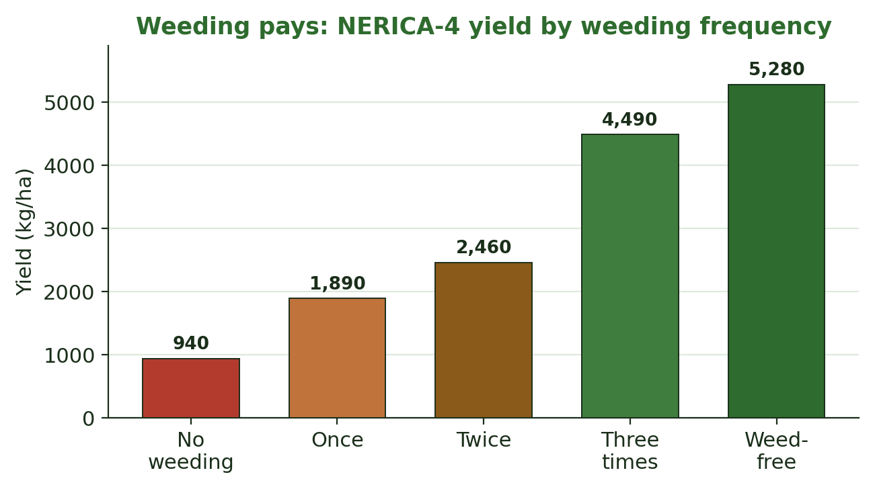
Figure. How weeding frequency affects rice yield. In NERICA 4 trials, yield rose from under 1 t/ha with no weeding to over 5 t/ha kept weed free, roughly a five fold gain.
The most damaging competition happens early, so keep the crop weed free through the first third of the season, and always weed before weeds set seed so they do not refill the weed seedbank. For upland rice, the minimum standard is to weed at least twice, around 3 and 6 weeks after the crop comes up.
The four ways to control weeds
- Preventive: use clean seed free of weed seeds, and keep bunds and canals clear so weeds cannot seed into the field.
- Cultural: good land preparation, flooding (which smothers most weeds in lowland fields), closer spacing so the canopy shades weeds out, and vigorous crops that out compete them.
- Mechanical: hand weeding and the rotary weeder, which only works if you planted in straight rows.
- Chemical: herbicides used correctly and as part of a plan, never as the only tool. Rotate herbicide modes of action to avoid breeding resistant weeds, and watch for weedy rice, which mimics the crop and is far easier to keep out with clean seed than to remove.
Get the rate right: If you spray, dose correctly with the herbicide application rate calculator.
What are the most common rice pests and how do you control them?
Quick answer: The major rice insect pests are stem borers, gall midge, leaffolder, caseworm, planthoppers, and rice bugs. Control them with Integrated Pest Management: grow a healthy crop, protect natural enemies, scout often, and spray only when damage crosses an economic threshold. Most insect damage does not justify spraying.
Here is the part that surprises new farmers. Most insect damage does not reduce yield enough to repay the cost of spraying, and broad spraying kills the spiders, wasps, and beetles that keep pests in check, which often makes the next outbreak worse. So the smart approach, Integrated Pest Management, is to grow a healthy crop, encourage natural enemies, scout regularly, identify the pest, and use chemicals only at a real threshold. In 2026, phone apps and drone images increasingly flag outbreaks early so action is timely.
| Pest | Tell tale sign | First line management |
| Stem borers | Dead central shoot, or empty white panicle | Resistant variety; balanced nitrogen; destroy stubble; threshold control |
| Rice gall midge | Tube like onion or silver shoot | Early synchronous planting; resistant variety |
| Leaffolder | Folded leaves with pale scraped streaks | Protect the flag leaf; conserve natural enemies |
| Caseworm | Leaf cases and patchy grazing | Drain the field for 4 to 6 days |
| Planthoppers | Hopperburn patches; spreads viruses | Resistant variety; avoid excess nitrogen and needless spraying |
| Rice and stink bugs | Stained, unfilled grain at the milk stage | Field hygiene; synchronous planting; threshold control |
| Rice weevil (store) | Holed grain in storage | Dry to 14 percent; clean, sealed or airtight storage |
Learn to recognise the natural enemies in your field, such as spiders, predatory bugs, and parasitic wasps, and protect them. A diverse, healthy paddy gives you free, continuous pest control that no spray can match. When in doubt, scout again before you spray.
Spray only when it pays: Check whether damage has crossed a real threshold with the pest economic threshold calculator or the IPM decision support tool, then get the dose and volume right with the pesticide dosage and mixing calculator and the spray volume calculator. Time applications with the weather based spray scheduler, or consider the biopesticide calculator for a softer option. See more in the pest and disease control calculators.
What are the most common rice diseases?
Quick answer: The main rice diseases are blast, sheath blight, brown spot, bacterial leaf blight, and, in Africa, Rice Yellow Mottle Virus. Resistant varieties, balanced nutrition, clean treated seed, and good field hygiene prevent more loss than any chemical, which is usually too costly for smallholders to justify.
One thread runs through nearly every rice disease. Resistant varieties, balanced nutrition (especially not too much nitrogen, which makes soft, disease prone tissue), clean treated seed, and field hygiene prevent more loss than any spray. Learn the diseases of your district and build your defence into the seed.
| Disease | Tell tale sign | First line management |
| Rice blast | Spindle lesions on leaves; neck and panicle blast | Resistant variety; avoid excess nitrogen |
| Sheath blight | Oval lesions climbing the leaf sheath | Avoid excess nitrogen and dense planting |
| Brown spot | Brown oval spots; a sign of poor soil | Improve fertility and drainage; clean seed |
| Bacterial leaf blight | Water soaked lesions turning grey white | Resistant variety; balanced nitrogen; clean seed |
| Rice Yellow Mottle Virus | Yellow mottling and stunting (Africa) | Tolerant variety; rogue infected plants; avoid ratoon |
| Sheath rot | Discoloured, trapped panicle | Manage borers and viruses; balanced nitrogen |
| Bakanae | Tall, thin, pale seedlings | Clean treated seed; resistant variety |
| Tungro (Asia) | Yellow orange discolouration, stunting | Resistant variety; manage leafhopper vectors |
Rodents, birds, and the invasive golden apple snail also cause heavy losses in places. Keep bunds narrow to deny rats nesting sites, scare birds from the milk stage to harvest, and manage snails by keeping water shallow when the crop is young and hand collecting them. Physiological problems such as heat or cold sterility at flowering, and lodging (the crop falling over), are best prevented with the right variety, sensible nitrogen, and adequate potassium.
Stay ahead of disease: Gauge your field’s risk with the crop disease risk index calculator, dose any fungicide with the fungicide application calculator, and respect withdrawal periods with the pre harvest interval calculator.
When and how do you harvest rice?
Quick answer: Harvest when about 80 to 85 percent of the grains have turned straw coloured and the lower grains are hard, usually at around 20 to 25 percent grain moisture. Drain the field about a week before, then cut with a sickle, reaper, or combine. Harvest on time, because too early gives light grain and too late means shattering and losses.
More rice is lost between a ripe field and a clean bag than most farmers realise, so the harvest is where careful work turns straight into money. Timing is a balance. Too early and grains are chalky and light. Too late and the crop shatters, lodges, and feeds the birds while quality falls.
Getting harvest timing and method right
- Judge maturity by colour: cut when roughly 80 to 85 percent of grains are straw coloured and the lower panicle grains are at the hard dough stage.
- Drain the field about a week before harvest to firm the ground and even out ripening, but not so early that you stress grain filling.
- Cut by sickle for smallholders, by reaper to speed manual systems, or by combine where fields are level and the scale justifies it. Combines have cut harvest time by around 40 percent in some regions.
- Handle bundles gently and thresh promptly. Every grain shed in the field is yield you grew but will never sell.
Nail the timing: Predict your harvest window with the harvest time predictor and the growing degree days calculator, then estimate your tonnage with the crop yield estimator.
How do you handle rice after harvest?
Quick answer: After cutting, thresh promptly, clean the grain, then dry it slowly to 14 percent moisture or below, losing less than 3 percent per day. Store it clean, dry, and protected from rodents and insects, ideally in airtight bags. Mill clean grain, which recovers about 67 percent milled rice from paddy.
The crop is not money until it is threshed, dried, stored, and milled well. In a low price year, post harvest quality is often where the thin margin is won or lost. Drying is the step farmers break most, and it costs them at the mill.
Drying: the make or break step
Wet paddy must be dried promptly to about 14 percent moisture for storage, but it must be dried slowly. Spread paddy 4 to 5 cm thick on a clean surface or tarpaulin, never on bare stony ground, and turn it every 30 to 60 minutes. Aim to lose less than about 3 percent moisture per day. Fast drying, whether in fierce sun in too thin a layer or with over hot mechanical air, cracks the grain inside, so it shatters into broken rice at milling. Broken rice sells for far less, so patience here is literally money.
Storage and milling
Store only well dried grain, because insects, moulds, and rodents undo your work otherwise. Keep moisture at or below 14 percent, use clean dry structures, and protect from re wetting. Airtight or hermetic storage has become a powerful low cost tool in 2026, controlling insects without chemicals by cutting off oxygen. Milling removes the husk and bran and recovers roughly two thirds, about 67 percent, milled rice from paddy. Two numbers set your value: total milled recovery and head rice yield, the share of whole unbroken grains that fetch the highest price. Both depend heavily on slow, careful drying.
Capture every premium. Nothing on a rice plant need be wasted. Rice bran feeds livestock and yields oil, husk fuels dryers and makes building material, and straw feeds animals or returns potassium and silicon to the field. Parboiling, branding clean local rice, and selling aromatic or organic lines all add value in a tight market.
Protect what you grew: Track drying with the grain moisture and dry weight calculator, budget storage with the crop storage cost calculator, and quantify any losses with the crop loss assessment calculator.
How much does it cost to grow rice, and is it profitable in 2026?
Quick answer: Rice can be profitable, but margins are tight in 2026 because prices are soft and inputs are dear. Budget every cost before you plant, multiply your paddy yield by about 67 percent milling recovery to get sellable rice, and compete on low cost per kilogram and clean, high quality grain rather than on volume.
Agronomy gets you a crop, but economics decides whether the crop was worth growing. The single most valuable financial habit is to write the budget before you plant, not after you sell. On the income side, multiply paddy yield by about 67 percent milling recovery, then by the price of milled rice.
| One acre upland rice (illustrative) | Amount |
| Seed, fertiliser, and sacks | About 195,000 |
| Land preparation and planting | About 250,000 |
| Weeding (twice) and bird scaring | About 160,000 |
| Harvesting, threshing, transport, milling | About 170,000 |
| Total cost | About 775,000 |
| Income (about 1,005 kg milled rice at local price) | About 1,809,000 |
| Net margin (illustrative) | About 1,034,000 |
Illustrative figures in local currency units. Your prices and yields will differ, which is exactly why you budget line by line before planting. These are starting points, not financial advice.
The whole result swings on your yield and your price, so cost control and quality matter enormously. To protect your margin in 2026, compete on cost per kilogram, protect milling quality by drying slowly, capture premiums from specialty or biofortified rice and from carbon credits, store grain to avoid selling everything at the harvest price low, and sell through a farmer group or contract where you can. Above all, manage your downside by choosing varieties that survive your worst likely season.
Build your budget: Start with the farm budget planner and the crop cost of production calculator, check your floor with the break even price calculator and the selling price calculator, and compare the season with the farm profit and loss calculator, the crop profit comparison calculator, or the farm labor cost calculator. Browse all the farm finance calculators.
What technology is changing rice farming in 2026?
Quick answer: In 2026, precision agriculture, drones, soil and water sensors, AI phone advisories, cheaper mechanisation, and digital traceability are lowering costs and protecting quality. Behind them, gene editing and marker assisted breeding are delivering drought, flood, heat, and salt tolerant varieties faster than ever.
You need not adopt all of this, but you should know it exists. The biggest payoff right now is cutting waste in the high priced inputs that squeeze margins. Precision tools such as laser land levelling, variable rate fertiliser, and sensor based irrigation put the right input in the right place at the right rate. Drones scout pests, map stress, and increasingly spray and seed. AI advisories deliver field specific weather, flood, and pest forecasts to a farmer’s phone.
Mechanisation keeps spreading as machines get cheaper and locally made, with transplanters and seeders speeding planting and combines cutting harvest time and losses. Digital and blockchain traceability proves how grain was grown, which is becoming a route to premium and export markets. Adopt what lowers your cost per kilogram or protects your quality and resilience, and ignore what is merely fashionable. The fundamentals in this guide still decide most of your result.
Weigh the investment: Pencil out any upgrade with the precision agriculture ROI calculator, the drone spray cost calculator, the smart irrigation ROI calculator, or the solar panel for farm power calculator. See more in the agritech calculators.
Rice growing calendar and quick checklist
Quick answer: A typical 120 day rice crop runs: plan and prepare before sowing, establish in the first 2 weeks, tiller and weed through weeks 2 to 6, topdress nitrogen at panicle initiation around day 50 to 60, protect the crop through flowering around day 85 to 90, then drain and harvest around day 110 to 120.
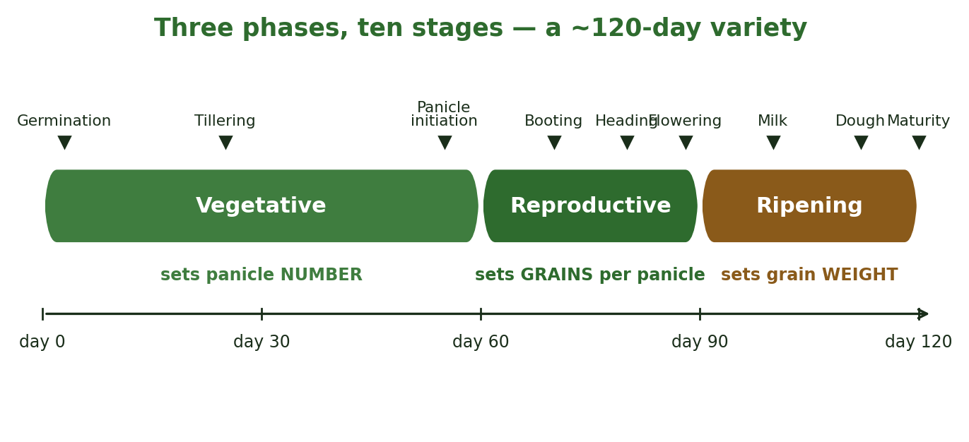
Figure. The rice growing stages across a 120 day season. The vegetative phase varies by variety, while the reproductive and ripening phases each last about 30 days.
Use this season map alongside your own district’s rainfall and temperature. Shift the day counts for shorter or longer varieties.
| Days from sowing | Stage | What to do |
| Before sowing | Planning | Choose variety to match water; test and treat seed; budget; prepare land |
| 0 | Sowing or transplanting | Sow 3 to 4 cm deep, or transplant seedlings under 25 days, in straight rows |
| 0 to 14 | Establishment | Keep moist or shallow water; refill gaps; guard against snails and birds |
| 15 to 45 | Tillering | First nitrogen and phosphorus; weed by weeks 3 and 6; scout pests |
| 50 to 60 | Panicle initiation | Main nitrogen topdress into 2 to 3 cm water; keep field wet |
| 60 to 90 | Booting to flowering | Protect the flag leaf; never stress for water; avoid heat and cold |
| 90 to 110 | Grain filling | Keep the canopy green; deter birds and bugs; resume AWD; plan harvest |
| 110 to 120 | Maturity | Drain about a week before; harvest at 80 to 85 percent straw coloured grain |
Frequently asked questions about growing rice
How long does rice take to grow?
Most rice varieties take about 100 to 150 days from sowing to harvest. Short duration varieties mature in under 105 days and let you fit two or three crops a year, while long duration varieties take over 140 days and can yield more where the season is long and water is secure.
How much water does it take to grow rice?
A flooded lowland rice crop uses roughly 1,000 to 2,000 mm of water over a season through the plant and through evaporation and seepage, which is why rice uses close to 40 percent of the world’s irrigation water. Water saving methods such as Alternate Wetting and Drying can cut that by up to about 30 percent without losing yield.
Can you grow rice without flooding the field?
Yes. Upland rice grows on free draining soil with no standing water, living on rainfall like any dryland cereal, and aerobic rice and dry direct seeding grow rice in moist but unflooded soil. These methods save water and labour, but they need suitable varieties and a stronger weed plan because flooding no longer suppresses weeds.
What is the best month to plant rice?
Plant rice to fit your water and temperature, not a fixed month. In rainfed systems, sow with the onset of reliable rains so flowering avoids both drought and the hottest part of the season. In irrigated systems you have more freedom, and dry season crops often yield more thanks to brighter sunshine and less disease.
Why is my rice yield low?
Low rice yield usually comes from a stack of small, fixable issues rather than one big failure: a thin plant stand, late weeding, nitrogen applied at the wrong time, water stress at flowering, or rushed drying. Break your yield into its four parts, which are panicles per square metre, grains per panicle, percentage of filled grains, and grain weight, then fix the biggest shortfall next season.
How deep should you plant rice seed?
Plant rice seed 3 to 4 cm deep. Emergence drops sharply with depth, from over 70 percent at 1 cm to about 2 percent at 6 cm, because deep sown seed runs out of energy and oxygen before it reaches the surface.
How do you increase rice yield?
Lift rice yield by choosing a variety suited to your water, planting a healthy stand at the right spacing and depth, weeding early, timing the main nitrogen dose to panicle initiation, never stressing the crop for water at flowering, and protecting the top three leaves from pests and disease. Then protect that yield with slow drying and careful milling.
Is rice farming profitable in 2026?
Rice farming can be profitable in 2026, but margins are tight because prices are soft and fertiliser and fuel are expensive. The growers who profit are those with the lowest cost per kilogram and the cleanest, best dried grain, and those who capture premiums from specialty rice, value addition, or carbon credit programmes.
What is Alternate Wetting and Drying in rice?
Alternate Wetting and Drying (AWD) is a water saving method where you let the field dry until the water sits about 15 cm below the soil surface, measured in a perforated tube, then re flood it. AWD cuts water use by up to about 30 percent and methane by 30 to 60 percent while keeping yield steady, and it can now earn farmers carbon credits.
Which rice variety is best for drought or flooding?
For flood prone land, choose submergence tolerant SUB1 varieties, which survive complete flooding for one to two weeks and then recover. For drought prone land, choose drought tolerant varieties such as the Sahbhagi Dhan family. In areas that face both, look for newer varieties that stack drought and flood tolerance together with disease resistance.
Growing rice well in 2026
Learning how to grow rice well comes down to a clear sequence: understand the plant, match your variety and method to your water, establish a healthy stand, feed and water it on time, protect it from weeds, pests, and disease, then harvest and dry it with care. Do those things in order and you will close most of the gap between a poor crop and a strong one.
In a soft price year, let quality and low cost be your edge. Keep simple records each season, fix the single biggest weakness next time, and your yields will climb while your costs fall. That is how good rice farmers compound small gains into a reliable living.
Ready to put this into practice? Pick the one section above that matches your next decision, whether that is variety choice, water management, or drying, and act on it this season. Run your own numbers with our irrigation and water calculators and farm finance calculators, or explore the rest of our crop growing guides and the full farm calculators library.